
Your employees refill their water bottles, grab a glass before a meeting, or fill up at the breakroom sink without giving it much thought. But how often do you stop and ask: What is actually in the water your team is drinking every day?
Water may look clear and taste fine, but that doesn’t necessarily tell you the full story about its quality. Water quality can vary from city to city, and even from one building to the next.
In recognition of World Water Monitoring Day, now is a great time to take a closer look at your office water. Office water quality testing can help you better understand what’s coming from your tap and whether your current water solution is delivering the quality and taste your employees expect.
What’s Actually in Your Office Tap Water?
Municipal water systems are required to meet drinking-water standards, but water can travel a long way before it reaches your office.
Along that journey, factors such as aging infrastructure, building plumbing, mineral content and treatment processes can affect the water coming from your faucet. Depending on the source and plumbing system, testing may identify substances or characteristics such as:
- Chlorine or chloramine used during municipal treatment
- Minerals that contribute to hard water
- Iron, copper or other metals
- Lead risks associated with certain older plumbing materials
- Total dissolved solids (TDS)
- Changes in taste, odor or appearance
This doesn’t mean your office water is necessarily unsafe. It means you can’t determine water quality simply by looking at it.
Office water quality testing replaces assumptions with actual information.
Why Water Quality Can Be Different From Building to Building
Two businesses located just a few miles apart can have noticeably different water. Why? The age of the building, condition of its plumbing, local water source, treatment methods and even where the property sits within the distribution system can all play a role. An older office building may also have very different plumbing than a newly constructed facility. That’s why relying solely on general information about your city’s water doesn’t always tell you exactly what’s happening at your tap.
Testing the water where your employees actually drink it gives you a clearer picture.
How Do You Test Your Office Water?
You don’t have to become a water expert to start asking better questions. A water quality test can evaluate specific characteristics of your water depending on the testing method being used. Results may include measurements such as Total Dissolved Solids (TDS), which indicate the concentration of dissolved substances in the water.

But numbers are only useful when you understand what they represent.
For example, a TDS reading by itself does not tell you whether water is safe or unsafe. It measures the amount of dissolved material, not exactly what those substances are. If there is concern about a specific contaminant, appropriate laboratory testing may be needed to identify it.
That’s an important distinction when evaluating office water quality testing: the goal isn’t simply to get a number. It’s to understand your water and determine whether your current treatment solution is appropriate for your workplace.
Filtration vs. Purification: What’s the Difference?
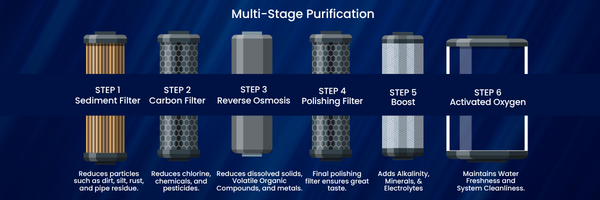
The terms filtered water and purified water are often used interchangeably, but they’re not necessarily the same thing. Basic filtration can help reduce certain particles, tastes, odors or contaminants depending on the type of filter being used. Purification systems can take water treatment further.
At Optimum Water Solutions, our reverse osmosis systems use a multi-stage process designed to reduce a broad range of dissolved substances and impurities while improving the taste and overall drinking experience.
That difference matters in an office. Employees aren’t simply looking for access to water. You want them to have water they actually want to drink.
Better-Tasting Water Makes Hydration Easier
Think about the water cooler in your office. Do employees regularly refill their bottles there? Or are they bringing bottled water from home, buying drinks throughout the day or avoiding the office water altogether? Taste and convenience can influence drinking habits.
When clean, refreshing water is readily available, choosing water becomes easier. And when the solution is located right where your team works, staying hydrated doesn’t have to feel like another item on the day’s to-do list. Better water can support a workplace culture where hydration becomes an easy, everyday habit.
Don’t Guess. Test It.
World Water Monitoring Day is a reminder that understanding water quality starts with paying attention to what’s actually in our water. Your employees drink from your workplace water supply every day. Isn’t it worth knowing more about it?
Optimum Water Solutions can help businesses evaluate their current workplace water and explore water purification solutions designed to provide consistently great-tasting water right at the point of use.
Don’t guess what’s in your office water. Test it.
Contact Optimum Water Solutions today to learn more about office water quality testing and discover how better water can make a difference for your workplace.

